
Short answer: a leak under a slab and a foundation that's moving can look alike, and one can lead to the other. Start with the water meter: turn everything off and see whether it still shows flow. If it does, a licensed plumber with a leak test is the right first call. If the meter is still and the cracks keep growing, a floor survey is. In Denton, a leak between the street and the meter box is the city's to fix; past the meter, it's yours.
Why the Two Get Mixed Up
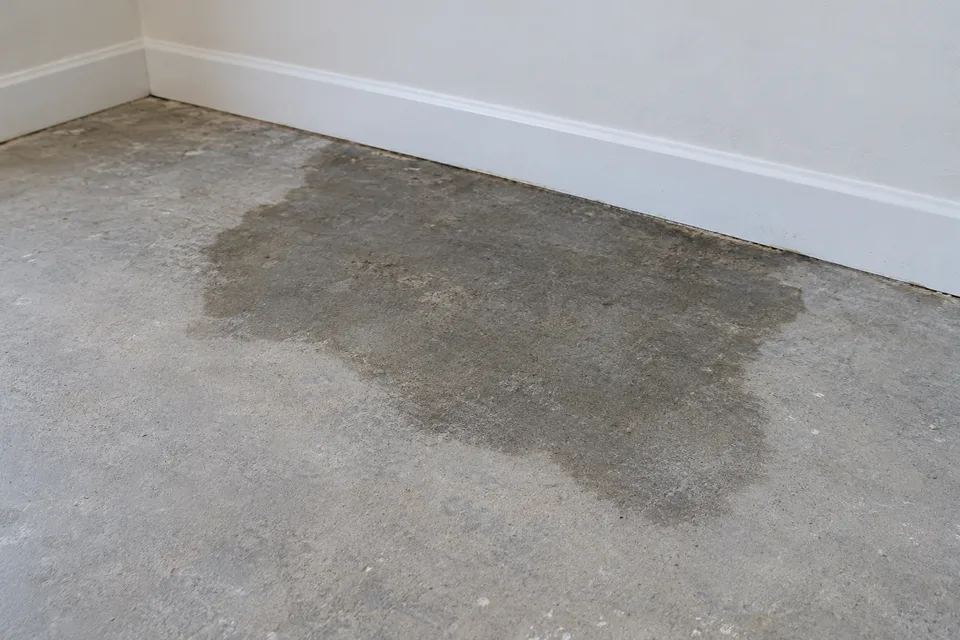
Both problems hide under the floor, and both can show up in the rooms above. A foundation that moves can crack walls and tile and make doors stick. Water from a leak can wet the clay under one part of a slab, and clay swells as it takes on water, the USDA says. The Texas engineers' guidelines favor soil moisture that stays near even on all sides of a house, and a leak does the opposite.
It can run the other way too. A plumbing engineering trade article from 2022 says that on a slab poured on the ground, the slab and the buried pipes under it typically move together as the soil swells and shrinks. When that movement damages a pipe, the article says, the slab is usually cut open above the break so the pipe can be fixed. So a moving foundation can lead to a leak, and a leak can help move a foundation.
That's why the honest answer to "is it the pipes or the foundation?" is often "check both." The good news is that each check is fairly simple.
A leak or shrinking soil
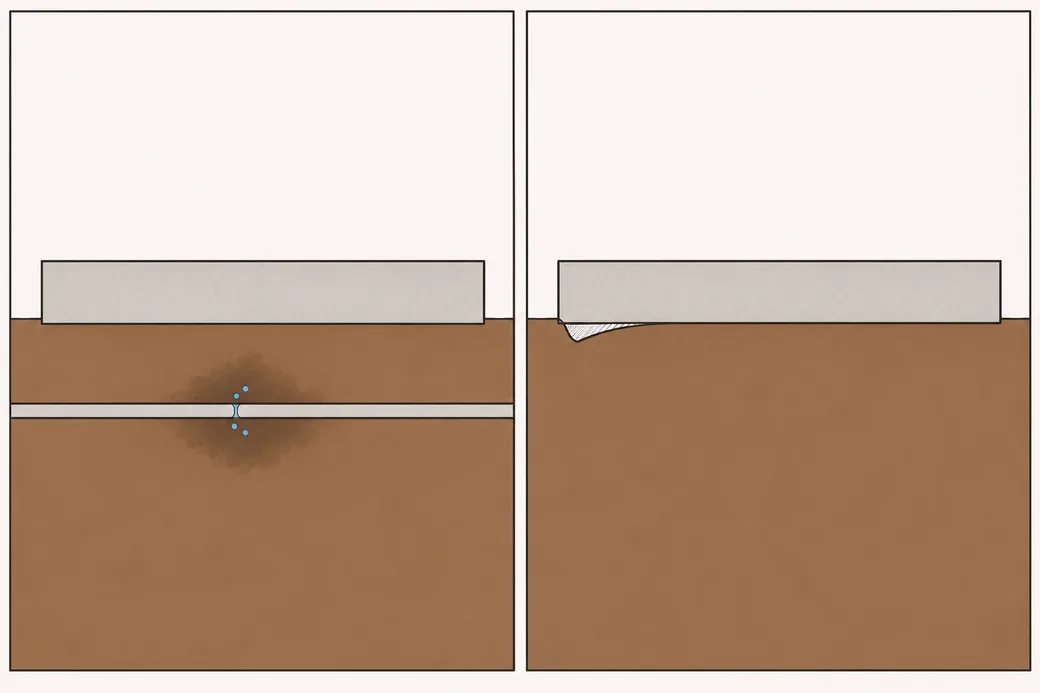
- A leaking pipe in the soil under a level slab
- Wet soil spreading out around the leak
- Dry soil pulled away from under one edge of a slab
The First Check You Can Do Yourself
Your water meter can tell you a lot in a few minutes. A Texas river authority's guide to its meters describes the method:
- Turn off all water inside and outside the house, so nothing is using any.
- Find the meter box. In Denton, it's usually in the front yard, under a round metal lid.
- Look for flow. With everything off, the meter's flow reading should be zero. If it shows flow, a leak is likely somewhere.
The same guide adds that if your own meter reading is far above what your bill shows, it's worth checking for a leak. The meter test won't say where the water is going. It could be a running toilet, a line in the yard or a pipe under the slab. It just tells you whether to call a plumber.
Who Owns the Leak in Denton
The City of Denton draws the line at the meter box. A leak between the street and the meter box is the city's responsibility, and you report it at (940) 349-7000. A leak between the meter box and your drain is the homeowner's, and the city's advice is to call a certified plumber as soon as possible.
Fixing that leak is plumbing work, and Texas requires a licensed plumber for it, with one exception: a property owner may do plumbing in their own homestead. In Flower Mound, water and sewer line repairs also need a permit, and the plumber must be licensed by the state and registered with the town. Other towns set their own rules, so ask yours.
How a Plumber Tests Lines Under a Slab
In 2005, a Houston investigative plumber described his company's method to the Foundation Performance Association, a Houston group of engineers and repair firms. He said there were no published standards for testing plumbing under a house, so leak detection companies had developed their own. His steps were:
- A hydrostatic test. The toilets are pulled, the drain lines under the slab are filled with water, and the level is watched for 30 minutes.
- A camera. If the lines don't hold water, a video camera goes into the line to look for the likely leak.
- Test balls. Inflatable balls block off sections of pipe, which are refilled one by one until the leak is found.
- A flow test, if needed, to see how much water is lost in normal use.
He also cautioned that a flow test right after a hydrostatic test may not be accurate, because the voids around a leaking pipe will already be full of water. That detail shows why a leak matters to a foundation: the water goes somewhere, and under a slab that somewhere is the soil.
Ask for the results in writing. A Foundation Performance Association repair guideline has the contractor provide a written report of the leak test done after a pier repair.
Pipe age matters
The same talk gave a feel for how long drain pipes last. He said cast iron usually lasts 35 to 50 years, though he had seen it fail in as little as 20. He called the ABS plastic pipe used from 1970 to 1975 "not so good," and said PVC, used since 1975, was performing much better. That was one plumber's experience in Houston, not a rule, but if your house is from the 1960s or 1970s it's a fair question to ask a plumber.
Leak Tests and Foundation Repair
The two trades meet again whenever a house is lifted. Any repair that jacks or lifts the house should include a leak test on the water and sewer lines, the Texas engineers' guidelines say. Leaks the test turns up should be fixed. An engineer's full investigation can include a plumbing test too.
Some repair companies build that test into their price. One company with a Lewisville office says its average repair cost includes a hydrostatic plumbing test by an outside plumber. When you compare quotes, it's worth asking whether a before-and-after leak test is included. Our cost guide covers what else to look for.
Which Call to Make First
There's no single rule, but these patterns are a reasonable guide:
- The meter shows flow with everything off. Call a licensed plumber first. If the leak is on the street side of the meter in Denton, call the city.
- The meter is still, and cracks are growing or floors slope. Start with a foundation inspection, which measures the floors.
- Both are happening. You'll likely need both. Fixing a leak first stops the water. A floor survey then shows whether the slab has moved and needs more.
If you're on the sandy middle band of Denton County, where the soil moves less, water deserves an extra-hard look whenever a crack keeps growing. Our soil and rock guide shows which band you're on.
Slab Leak Questions
Can a slab leak damage my foundation?
It can. Water from a leak wets the soil under part of the slab, and clay swells as it takes on water. That's the uneven moisture the Texas engineers' guidelines warn against. Whether it has moved your slab is what a floor survey shows.
Who pays for a leak in Denton?
It depends on where it is. Between the street and the meter box, it's the city's to fix. Between the meter box and the house, it's yours.
Can my foundation company fix the leak?
Only if the work is done by a licensed plumber. Texas requires a plumbing license for plumbing work, except for an owner working on their own homestead. Some repair companies bring in an outside plumber for leak tests, as the Lewisville company's average shows.
Sources
- City of Denton, FAQ on who is responsible for a water leak.
- Texas Occupations Code §1301.351 and §1301.051 (plumbing licensing).
- Town of Flower Mound, residential permit guidelines (plumbing).
- Foundation Performance Association, January 2005 meeting summary, "Plumbing Tests and Repairs and Reroutes."
- Paper FPA-SC-08-1, Foundation Performance Association.
- "Protection of Plumbing from Expansive Soil," PHCP Pros, July 2022.
- Red River Authority of Texas, meter reading guide.
- Guidelines for the Evaluation and Repair of Residential Foundations, Version 3, Texas Section of the American Society of Civil Engineers.
- Linear extensibility classes from the National Soil Survey Handbook, as published by SoilWeb, UC Davis.
- A repair company's Lewisville location page.