
Short answer: clay under a house does best when the soil around it stays evenly moist, not soaked and not cracked dry. Most towns around Denton treat a soaker hose, drip line or hand-held hose more gently than a sprinkler, but each town words its rule differently, and a drought stage can tighten it. Set the hose a little out from the foundation, water slowly and evenly on every side, and check your own town's current notice first.
Why Watering a Foundation Helps
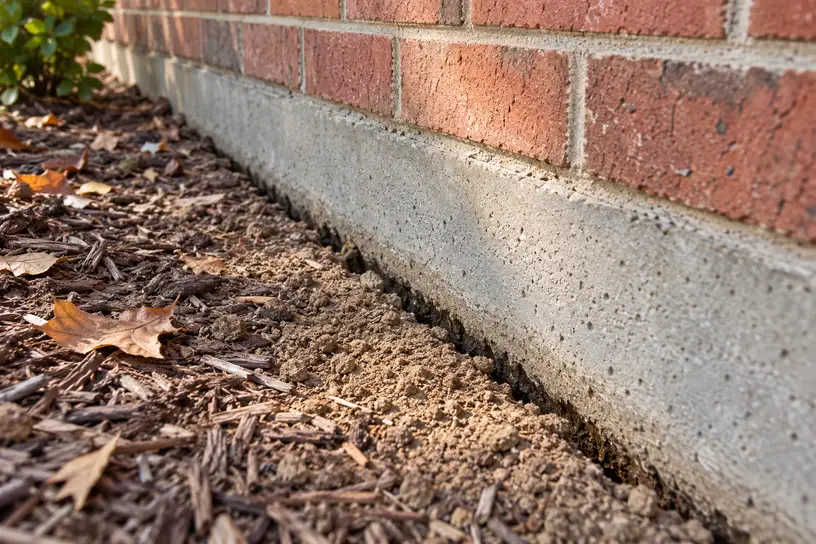
Clay grows when it takes on water and shrinks when it dries. The USDA measures that with a number called linear extensibility, and it says that once a soil rates moderate or higher, "shrinking and swelling can damage buildings." A house on clay rides that movement. When one side dries out faster than the others, that side can drop, and cracks can follow.
The goal of watering is to make the change smaller and more even. The Texas Section of the American Society of Civil Engineers says keeping soil moisture near uniform on all sides of a foundation may be beneficial. The Foundation Performance Association, a Houston group of engineers and repair firms, says that for most repair systems to work well, the moisture under and around a foundation has to be kept steady and rainwater has to drain away from it.
Summer is when it matters most. NOAA's Denton 2 SE station averages 4.86 inches of rain in May and 4.64 in October, its two wettest months. In between come the hottest: average highs of 95.9°F in July and 95.8°F in August. At the Denton Municipal Airport station, July averages just 1.77 inches of rain.
Which Band Needs It Most
How much watering helps depends on what's under the house. We sampled the USDA soil survey at 25 points in and around each of 33 towns:
- West band (Krum, Sanger, Roanoke and nearby): 72.6% of land points on soil rated high or very high. Sanger clay reads 8.4 right at the surface.
- East band (Frisco, The Colony, Little Elm and nearby): 85.4% high or very high. Houston Black clay reads 12 from the top down.
- Middle band (Corinth, Lantana, Highland Village, Flower Mound, Trophy Club and nearby): 20.7%. The common soils there have a sandy top over a moderate clay layer.
On the clay bands, steady moisture is part of looking after a foundation. On the middle band, the soil moves less, so if a crack keeps growing, too much water may be the problem rather than too little. A leak, a downspout that empties at the wall or a yard that slopes toward the house can all soak one side. Our soil and rock guide shows how to find your band.
How to Set Up a Soaker Hose
The clearest official advice in our area comes from Flower Mound. The town says to put a soaker hose or drip line 8 to 18 inches from the foundation and water until the soil is soaked 8 to 10 inches deep.
Why 8 to 10 inches? On the middle band's common soils, the sandy top is only 5 to 8 inches thick on Birome and Callisburg, so that depth reaches the clay layer below, the part that moves most. On the clay bands, the clay starts at or near the surface, so the same depth wets it directly.
A few habits make it work better:
- Go all the way around. The point is even moisture on every side, not extra water at the corner with the crack.
- Water slowly. A soaker hose is meant to seep. Water that runs off onto the driveway or street isn't reaching the soil, and Frisco bans runoff into streets outright.
- Check the depth. Push a trowel or a long screwdriver into the soil an hour or so after watering to see how far down it's damp.
- Don't overdo it. More isn't better: the Texas engineers' guidelines specifically caution against excessive watering. Soggy clay can swell and push a slab up.
- Keep the slope. Rain should run away from the house, not toward it.
We haven't found a published run time for this area, and soils differ from lot to lot. The depth check is the best guide.
Town-by-Town Rules for Foundation Watering
Each town words its rules differently, and some don't mention foundations at all. Here's what each town's own page says, as read in October 2026.
- Denton: from June 1 to September 30, watering is allowed only from 6 p.m. to 10 a.m., except hand-watering and soaker hoses for foundations, which are exempt.
- Lewisville: in Stage 1, hand-watering and soaker hoses are allowed at any time, and the city says that includes foundations. In Stages 2 and 3, they're restricted.
- Flower Mound: hand-held hoses, buckets and drip irrigation are allowed at any time. The town's foundation advice names soaker hoses, but its any-time list doesn't, so ask the town about them.
- Roanoke: hand-held hoses, drip, soaker hoses and bubblers any day, at any time, "for the protection of structural foundations," trees and plantings.
- Trophy Club (Trophy Club MUD No. 1): soaker hoses and drip any time on any day except Monday; hand-held hoses any day.
- Little Elm: the town's Stage 2 guide allows foundations up to two hours on any day by hand-held hose, soaker hose or drip. The guide isn't dated.
- Frisco: lawns on your trash day. The schedule page allows hand watering with a shut-off nozzle and drip, but doesn't mention soaker hoses or foundations. Ask the city.
- Highland Village: no outdoor watering of lawns and planted beds from 10 a.m. to 6 p.m., May 1 to September 30. Hand watering of shrubbery is allowed at any hour in that phase, but foundations aren't named, so ask the city.
- Corinth: we couldn't open the city's page. Search results quote it with Stage 1 wording like Lewisville's. Confirm with the city.
- The Colony, Krum, Sanger and Lantana: we couldn't find a published foundation rule. Ask the city, or the district on your water bill.
Drought Stages Change the Rules
These rules aren't fixed. Cities move between stages as demand, supply or repairs change. Denton, for one, entered Stage 1 of its drought plan on August 19, 2026, after increased demand and unexpected repairs at a water treatment plant.
When a stage tightens, foundation watering can be among the things that change. Lewisville restricts hand-watering and soaker hoses in Stages 2 and 3. Highland Village limits hand watering to evening and night hours in its Phases II and III. Lewisville buys its water from Dallas Water Utilities and follows rules in line with Dallas's, so a change there can reach Lewisville too.
So before you set a routine, check your city's or water district's current notice. What was allowed last summer may not be allowed this one.
Trees, Gutters and Slope
A hose isn't the only thing that changes the moisture around a house. Trees draw water out of the soil as they grow, and the Texas engineers' guidelines warn that taking a tree out near a foundation may result in upheaval. If you're thinking of removing a big tree close to the house, that's worth asking about first.
Gutters and downspouts matter just as much. A downspout that empties against the wall soaks one spot every time it rains, which is the uneven moisture watering is meant to prevent. Run it out into the yard, and keep the ground sloping away from the house, at least 6 inches over the first 10 feet, as the same guidelines call for.
When Watering Isn't the Fix
Watering keeps the soil steady. It doesn't lift a slab that has already dropped, and it can't make up for a leak or bad drainage. If cracks keep growing even with careful watering, it's time to measure. A free foundation inspection checks the floor levels, and our slab leak guide covers what to do if water under the house is the real cause.
Watering Questions
What distance from the slab does the town advice give?
Flower Mound's advice is 8 to 18 inches from the foundation. That's the only published figure we found from a town in this area.
How long should I run it?
We haven't found a published time for Denton County, and soils differ. Water slowly, then check how deep the soil is damp. Flower Mound's target is 8 to 10 inches.
Does a drought stage stop foundation watering?
It depends on the town and the stage. Denton exempts soaker hoses for foundations from its summer hours, and Lewisville allows them in Stage 1 but restricts them in Stages 2 and 3. Check your town's current notice.
Is watering worth it on sandy ground?
It matters less there. On the middle band's sandy soils, too much water is a likelier problem than too little. Keep the soil steady, keep rainwater running away from the house, and look for leaks if a crack keeps growing.
Sources
- Watering and drought pages of the City of Denton, the City of Lewisville, the Town of Flower Mound, the City of Frisco, the Town of Little Elm, the City of Highland Village, the City of Roanoke and Trophy Club Municipal Utility District No. 1, read in October 2026.
- Guidelines for the Evaluation and Repair of Residential Foundations, Version 3, Texas Section of the American Society of Civil Engineers.
- Paper FPA-RC-01-0, Foundation Performance Association.
- 1991-2020 normals for the Denton 2 SE and Denton Municipal Airport stations, NOAA National Centers for Environmental Information.
- Linear extensibility classes from the National Soil Survey Handbook, as published by SoilWeb, UC Davis.
- SSURGO soil survey data for Denton, Collin and Tarrant counties, read through Soil Data Access, USDA Natural Resources Conservation Service.